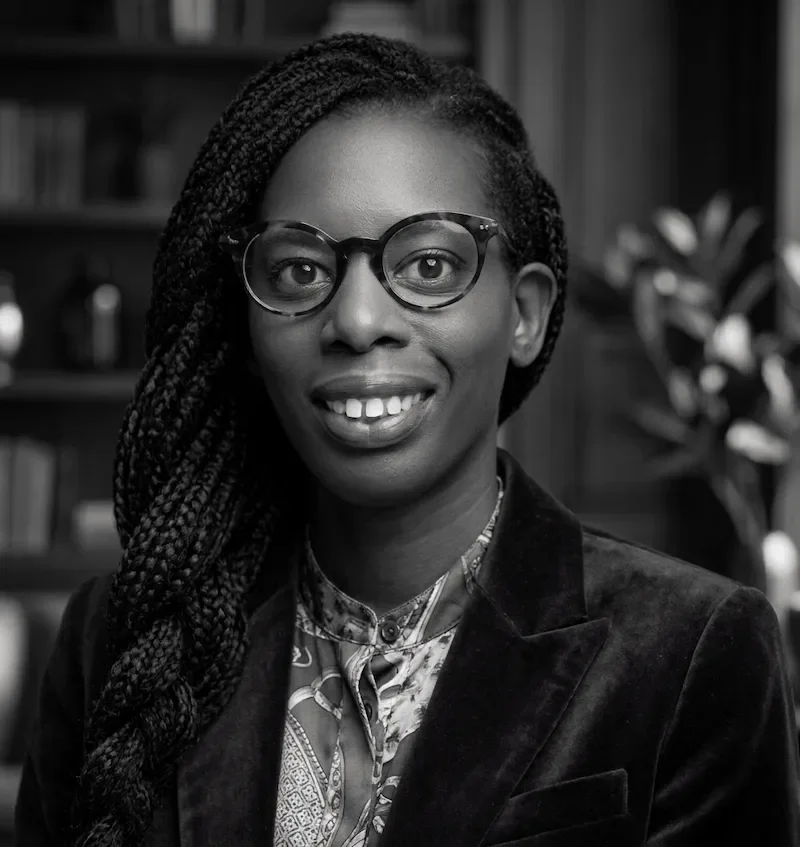
Adanma Wokoh
Senior Marketer, BCG · Founder, Crafting Joy · Founder, The Creative Pause
The Founder
I found my creativity inside corporate life.
Barclays
shell
nCino
BCG
Fifteen years as a senior marketer. Barclays. Shell. nCino. BCG. And somewhere in the middle of all of it — I stopped being creative without noticing. This is the story of finding it again, and why I built something to help others do the same.
Part one
Losing it quietly
There was no moment when I decided to stop being creative. It happened the way most things happen in corporate life — slowly, incrementally, through a thousand small decisions that each made complete sense at the time.
I joined Barclays in my mid-twenties full of ideas. I had opinions about everything. I'd sketch concepts in meetings, push back on briefs that felt generic, propose things that hadn't been done before. Some of it landed. A lot of it didn't. And over time I learned — the way you learn anything in a large organisation — what was worth the energy and what wasn't.
By my early thirties I was good at my job. Really good. I knew how to shape a message. How to read a room. How to get a campaign approved across four layers of stakeholders without anyone feeling uncomfortable. I had developed a precise sense for what would pass and what would get killed — and I unconsciously began to only produce the former.
“I had stopped creating things. I had started manufacturing approvals.”
The irony is I didn't notice. The work was still good. The results were still strong. I was still described, in performance reviews, as a creative thinker. But the kind of creativity I was doing had quietly changed. I was no longer making something. I was optimising for consensus.
Part TWO
The burnout
I burned out in 2021. Not dramatically. Not in a way that anyone would have noticed from the outside. I kept working. I kept delivering. But something had gone out.
I remember sitting at my desk one afternoon, looking at a brief I'd written, and thinking: I don't know what I actually think about this. Not because the brief was complicated. Because I had spent so long filtering my thinking through what was expected that I'd lost track of where the filter ended and I began.
I was 38 years old and I couldn't tell you what I genuinely found interesting anymore. Not in a work context. I had become very good at finding things strategically useful, commercially relevant, on-brand. But interesting? Exciting? Worth making just because it was worth making? I had no idea.
“I had become very good at finding things strategically useful. But interesting? Worth making just because it was worth making? I had no idea.”
What followed was six months of doing less. Not by choice, initially — I had to. And in that space, something unexpected happened.
Part three
Doodling back
I started doodling. Which sounds almost embarrassing to say, but there it is. Small drawings in notebooks. Patterns, shapes, little illustrated thoughts. Nothing I would have shown anyone. Nothing with a strategy behind it. Just making marks for the pleasure of making marks.
I noticed something after a few weeks of this. The meetings I had after I'd spent an hour drawing were different. I had more to say. I was less focused on what was expected and more focused on what was actually interesting. I was asking better questions. I was less attached to my own prior thinking.
I don't think this was about drawing. I think it was about having a practice of making things without consequences — a space where I was allowed to be bad, experimental, uncertain, and still keep going. That space had been missing for years. Once it was back, even in this tiny form, something shifted.
“I had become very good at finding things strategically useful. But interesting? Worth making just because it was worth making? I had no idea.”
I didn't leave corporate life to find my creativity. I found my creativity and it made me better at the life I already had. More present. More confident in my instincts. More willing to say the thing I actually thought rather than the thing that would be easiest to agree with.
Part FOUR
Crafting Joy
Crafting Joy started as a way of sharing what I'd found. The belief that making things — really making things, with your hands, without a strategic objective — does something to the rest of your thinking. That the capacity is in everyone. That it atrophies when you stop using it. That it comes back.
It began as a creative practice brand: workshops, tools, ideas about how to build making into a life that doesn't naturally make space for it. It evolved from there.
Crafting Joy
A creative practice brand built on the belief that everyone is creative — and that the capacity comes back when you start using it again. Workshops, tools, and practices for people in ordinary lives who want to make things that matter.
Creative Workshops
In-person and virtual sessions for individuals and teams
The Creative Pause
52 prompt cards for the desk, the meeting, the stuck moment
Founder's Circle
Early access, expansion packs, and a community of practice
The Creative Pause is the part of Crafting Joy built specifically for corporate life. Not for the studio. Not for the weekend. For the desk at 3pm on a Tuesday when you're stuck and you need to think differently for five minutes.
Part FIVE
The Creative Pause
The idea for the cards came from watching what happened when I gave people a single prompt in a workshop setting. The quality of thinking that emerged — from people who had described themselves, five minutes earlier, as not creative — was consistently surprising. Not just to me. To them.
The prompt didn't make them creative. They already were. It just interrupted the pattern long enough for something different to surface.
I wanted to make that interruption available outside a workshop. At the desk. In the meeting. In the five minutes before a difficult conversation. Not as a ritual that required time and space and intention — but as something you could pull from a box, read, and let sit with you while you worked.
“The prompt didn’t make them creative. They already were. It just interrupted the pattern long enough for something different to surface.”
The deck is 52 cards across four categories: Begin, Experiment, Reflect, Release. Each one is a question. Not a technique. Not an exercise. A question that gets you out of the automatic and into something more considered.
The World Economic Forum's 2025 Future of Jobs Report names creative thinking among the top skills rising in importance through 2030. I believe that. But I also believe that telling people to be more creative without giving them a practice to work with is close to useless. The cards are a practice.
Part SIX
What I believe
I believe that everyone is creative. Not as a motivational claim. As a factual one. The capacity for original thinking, for making unexpected connections, for producing something that didn't exist before — that's not a personality trait. It's a human capacity. It weakens when you stop using it. It comes back when you start.
I believe that corporate life, at its current pace and with its current incentive structures, works against that capacity in ways that most people don't notice until they've already lost significant ground.
And I believe that AI is accelerating this. Not because AI is bad — I use it every day — but because the path of least resistance, when you have access to instant output, is to stop doing the generative work yourself. The muscle atrophies faster when it has a prosthetic.
“The skills that survive AI are the human ones. And the human ones need practice.”
The Creative Pause is built for people who are still in corporate life and want to stay creative within it. Not people who are leaving. Not people who have already figured it out. People in the middle — doing good work, aware that something is missing, not sure where to start.
I built it for them because I was one of them.
— Adanma
What to do next
Three ways to begin
Preorder · Ships September 2026
Get the deck
52 prompt cards. Four categories. One practice. The Founder Edition is numbered, signed, and limited to the first 100. After they're gone, they're gone.
For organisations
Bring it to your team
From self-hosted team kits to facilitated half-day workshops. The Creative Pause for the room, not just the desk. Booking opens January 2027.
For organisations
Talk to Adanma
From self-hosted team kits to facilitated half-day workshops. The Creative Pause for the room, not just the desk. Booking opens January 2027.
Crafting Joy — The Creative Pause
© 2026 Crafting Joy. All rights reserved.